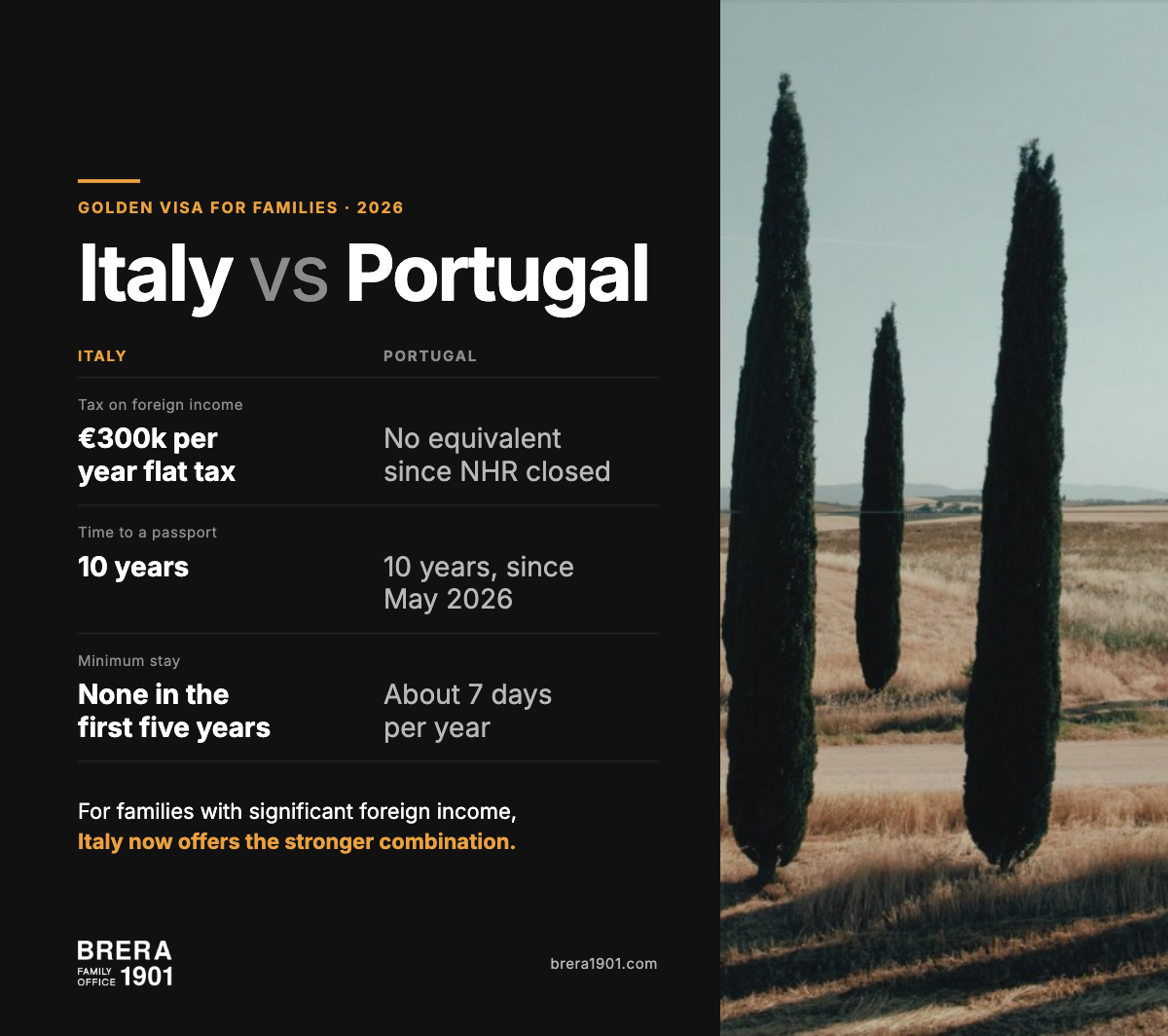

If you move your tax residence to Italy in 2026, the Italy flat tax for foreigners lets a single annual payment cover all the income you earn outside the country:
€300,000 per year, for up to 15 years.
Dividends from a New York brokerage account, rent from a Toronto condo, distributions from a Delaware fund: whatever they add up to, the Italian bill on that income stays the same. Each family member you bring into the regime pays €50,000 a year on the same terms.
The figure has tripled since the regime opened in 2017. For investors with seven-figure foreign income the arithmetic still favours Italy, though timing now carries a price it didn’t carry before.
How the Italy Flat Tax Works in 2026: The Mechanics
The regime lives in Article 24-bis of the Italian Income Tax Code (TUIR). Once you opt in, a fixed substitute tax replaces Italy’s progressive income tax on everything produced abroad. Ordinary Italian rates reach 43%, before regional and municipal surcharges.
The €300,000 covers foreign dividends, interest, capital gains, foreign rental income, pensions and business income produced outside Italy. Three benefits come with it:
- No IVIE or IVAFE, the Italian wealth taxes on foreign real estate and foreign financial assets
- No RW reporting of foreign holdings on your Italian return
- Italian inheritance and gift tax limited to assets located in Italy
Family offices tend to underestimate the third point. A portfolio held in the United States can pass to the next generation with no Italian inheritance tax for as long as the regime is active.
Some income stays outside the flat amount. Anything produced in Italy (an Italian salary, rent from an apartment in Brera, profits from an Italian company) is taxed at ordinary rates. Gains on the sale of qualified shareholdings within the first five years are also taxed ordinarily. Italy grants no credit for foreign taxes paid on income the flat tax already covers.
You can also leave specific countries out of the option. Income from those countries is then taxed at ordinary Italian rates, with a credit for tax paid there. For an American investor whose income is already taxed by the IRS, this choice deserves a proper model before the first return is filed.
When the Flat Tax Pays Off
Where does the regime start to pay? Once surcharges are counted, the break-even sits at roughly:
€650,000 to €700,000 of annual foreign income.
Below that, ordinary taxation usually costs less. Above it, every additional dollar earned abroad arrives in Italy with no further Italian tax.
That threshold assumes income taxed at ordinary progressive rates. Italy ordinarily taxes dividends and capital gains at 26%, so for a portfolio made mostly of financial income the break-even moves above €1.1 million. Higher up, the effective rate falls quickly: €5 million of foreign income means an effective 6%, €10 million an effective 3%.
Italy Flat Tax in 2026: From €100,000 to €200,000 to €300,000
Italy has raised the flat amount twice. Each investor keeps the figure that applied when they moved:
| Tax residence transferred | Annual flat tax | Each family member |
|---|---|---|
| Before 10 August 2024 | €100,000 | €25,000 |
| 10 August 2024 to 31 December 2025 | €200,000 | €25,000 |
| From 1 January 2026 | €300,000 | €50,000 |
The first increase arrived with Decree-Law 113/2024, the second with the 2026 Budget Law (Law 199/2025), approved on 30 December 2025. Neither applies retroactively. An investor who settled on Lake Como in 2019 still pays €100,000 today, and will until the fifteen years run out.
Two things follow from this history.
The trigger is the date your habitual residence actually moved to Italy. Filing the election later does not change the figure you lock in. Moving your life to Milan in December or January can mean a difference of €100,000 a year, over fifteen years.
The direction is also clear. Italy took the figure from €100,000 to €300,000 in about seventeen months and left the structure of the regime untouched. Our reading: the regime is here to stay, and its price follows demand. Anyone planning a move in the next few years should treat today’s figure as the one worth securing.
Is €300,000 the right number for your income? Book a private assessment with a Brera 1901 advisor and see the regime modelled on your own portfolio.
Italy Flat Tax 2026 vs Other European Regimes
Look at the alternatives in Europe today. The UK abolished its non-dom regime in April 2025. Portugal closed the NHR and replaced it with IFICI, which targets specific professions. Spain’s Beckham regime applies its 24% rate only up to €600,000 of employment income and is built around salaried workers.
For investors with complex international portfolios, Italy’s regime stands almost alone: a fixed price on all foreign income, open to any nationality, for fifteen years.
Who Qualifies and What “New Resident” Means
Nationality plays no role. Americans, Canadians and Italian citizens returning after a decade abroad qualify on the same terms. Three conditions apply:
- You transfer your tax residence to Italy. In practice this means registering with the Italian civil registry, or having your habitual abode or centre of interests in Italy for most of the tax year.
- You were not an Italian tax resident in at least nine of the previous ten tax years.
- You make the election in the Italian tax return for the year of the move or the following year.
For extra certainty before relocating, you can ask the Italian Revenue Agency for an advance ruling on your specific position.
The option lasts up to 15 years, and you can revoke it at any time.
North American investors have one more layer to plan. The United States taxes its citizens on worldwide income wherever they live. The flat tax sets what you owe Italy, and your IRS position needs its own model alongside it. Canadians who give up Canadian residence should look at the departure tax on the deemed disposition of their assets before the move date is fixed.
Family Members
Each family member listed in Article 433 of the Italian Civil Code can join the regime for €50,000 a year, provided they also meet the nine-out-of-ten-years test. For a couple with two adult children, the 2026 cost is €450,000 a year.
Weigh that figure against each person’s own foreign income. Adding a family member with modest income abroad rarely pays. Adding an adult child who already receives significant distributions often does.
Flat Tax and the Investor Visa: How They Work Together
The Investor Visa gives a non-EU investor the right to live in Italy. The flat tax sets how Italy taxes that investor’s foreign wealth once they do. Different authorities handle the two decisions, and they reach their full value only when planned as one.
A residence permit on its own does not make you an Italian tax resident. Your tax position starts on the day your life actually moves here: the apartment, the school enrolment, the months spent in the country. For an investor holding a visa, that date decides which of the three flat tax figures applies.
The investment behind the visa also matters. Capital placed in an Italian company to meet the Investor Visa requirements generates Italian-source income, which follows ordinary Italian rules. Everything held abroad falls under the flat amount. Seen together, the two pieces form a single structure: one part of the wealth works in Italy, the rest stays where it is, taxed at a known cost for fifteen years.
Most of the investors we work with already know Italy well. They have walked the Quadrilatero in October, or spent summers in a family house in Puglia. The flat tax is often what turns that familiarity into a plan with a date on it.
Frequently Asked Questions
How much is the Italy flat tax in 2026?
€300,000 a year for investors who transfer their residence to Italy from 1 January 2026, plus €50,000 for each family member included in the regime.
Can US citizens benefit from the Italian flat tax?
Yes. US citizens can opt into the regime. The United States keeps taxing its citizens on worldwide income, so the interaction between the two systems needs a model before the move.
How long does the flat tax last?
Up to 15 years from the first year of the option. You can revoke it at any time.
Does the flat tax apply to Italian income?
Income produced in Italy follows ordinary Italian rules. The flat amount covers income produced abroad.
Plan Your Move With a Clear Number
The €300,000 regime rewards investors who decide early and time the move with precision. A private assessment with Brera 1901 covers your foreign income, the countries worth excluding, the position of your family members and the right moment to transfer residence.
This article is for general information only and does not constitute legal, tax or investment advice. Rules and thresholds may change. Consult qualified professionals before making any decision.